
News
FGD on Synergizing Banking Sector: Lenders’ and Borrowers’ Perspective held at DCCI
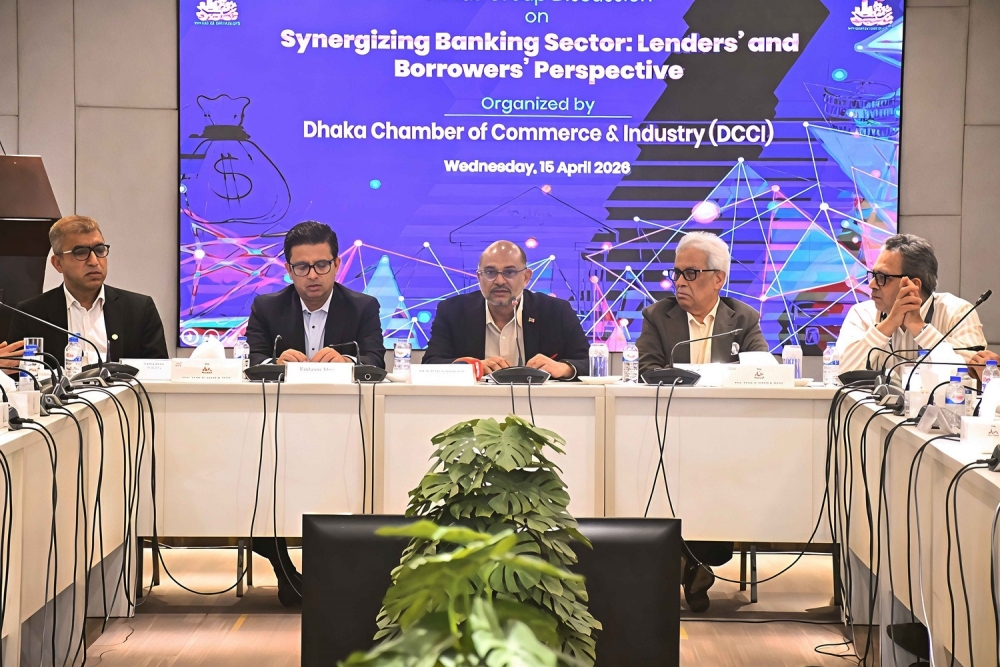
DCCI President Taskeen Ahmed in his presentation said due to a prolonged lack of a business-friendly environment, the country’s industrial sector is going through a highly challenging period, marked by declining production, rising outstanding loans in the industrial sector, a high rate of non-performing loans, reduced credit flow to the private sector despite no liquidity shortage, and increased government borrowing from the banking sector. To overcome this situation, DCCI President Taskeen Ahmed emphasized the need for structural reforms in the banking sector, ensuring stability and good governance, as well as strengthening effective coordination between the banking sector and the private sector. He said, many businessmen and many SMEs have been suffering for a few willful defaulters.
He made these remarks at a focus group discussion titled “Synergizing the Banking Sector: Lenders and Borrowers’ Perspective,” organized by the Dhaka Chamber of Commerce & Industry (DCCI) on April 15, 2026.
DCCI President later recommended undertaking structural reforms in the banking sector, ensuring stability and good governance in the banking system, and prioritizing financing for domestic industries rather than placing excessive emphasis solely on export-oriented sectors.
Being the Chief Guest of the discussion, Dr. Rashed Al Mahmud Titumir, Adviser to the Prime Minister, Ministry of Finance and Planning, Government of Bangladesh emphasized that the development of the CMSME sector is synonymous with the overall national development. “We want to see a strong CMSME base in the country”, he added. He called for a collaborative effort between the Dhaka Chamber and the government to drive this sector move forward. Highlighting the necessity of a coordinated economic framework, he stated that reforming the Bank Company Act and other financial laws is inevitable.
To establish a long-term sustainable credit system, he stressed the importance of building a strong bond market and a capital market as an alternative financing model. The government is committed to supporting labor-intensive industries to boost job creation. Efforts will be made to re-open closed government factories and increase production across the industrial sectors, and provide necessary support to the women entrepreneurs, he added. Acknowledging the current fragile state of the financial sector, the Advisor assured that necessary policy formulations and structural reforms are being undertaken to ensure recovery.
Chairman of Bangladesh Association of Banks (BAB) Abdul Hai Sarkar, Director (SME & Special Programmes Department) Bangladesh Bank Nawshad Mustafa and Director (Research) Selim Al Mamun, Managing Director of NCC Bank PLC M. Shamsul Arefin and Deputy Managing Director of City Bank PLC Ashanur Rahman also spoke at the event as designated discussants.
BAB Chairman Abdul Hai Sarkar said that there is no alternative to simplifying SME financing and private banks have now come forward to finance this sector. He also expressed the view that there is a lack of coordination between the government's policy makers and relevant stakeholders, which needs to be addressed.
Naushad Mostafa, Director (SME and Special Programs Department) of Bangladesh Bank, highlighted a critical challenge in the financial sector is the significant lack of authentic and accurate data. He noted that this data gap creates major obstacles to effective decision-making. To address this, he emphasized the urgent need to enhance AI-based connectivity among all service providers, financial institutions, including government agencies, to ensure better data flow and more informed policy-making.
Selim Al Mamun, Director (Research) of the Central Bank, said that we cannot change the negative aspects overnight. He also observed that despite having excess liquidity in the system, there is a noticeable lack of dynamism in the private sector due to lack of macroeconomic stability. To counter this, he emphasized the urgent need to improve the Ease of Doing Business index to regain investors’ confidence. He also informed that the central bank is actively taking initiatives to bring inflation down to around 7%.
Md. Abdul Wahab, Director (Research) of Bangladesh Bank, emphasized on alternative financing model apart from the traditional banking system. Right at this moment, the liquidity scenario is quite impressive. We have to create a strong bond market and a strong capital market as well. Furthermore, he urged the private sector not to rely solely on banks for financing, but rather to increase dependency on alternative financing sources, such as the bond market and other related sectors.
M. Shamsul Arefin, Managing Director of NCC Bank PLC, stated that banks are currently prioritizing the financing of eco-friendly green projects, and he encouraged entrepreneurs to focus more on such ventures. He also observed that the lack of proper business record-keeping and documentation among CMSME entrepreneurs is a major obstacle hindering their access to bank loans.
Ashanur Rahman, Deputy Managing Director of City Bank PLC, stated that the implementation of IFRS 9 starting next year will reduce the scope for maintaining excess loan provisions. He noted that the potential of the CMSME sector is not being fully utilized; therefore, it is crucial for the Central Bank to increase the Credit Guarantee Scheme limits and simplify the documentation required for loan applications. Furthermore, he emphasized the necessity of a dedicated marketplace for CMSME entrepreneurs, stating that without it, they would struggle to sell their products, which would ultimately hinder the banks' loan recovery and lending processes.
DCCI Vice President Md. Salem Sulaiman, members of the Board of Directors, entrepreneurs, and representatives from public and private sector were present during the roundtable.
Published on: 2026-04-15