
News
Seminar on “Canal Excavation in Bangladesh: Revitalizing Circular Waterways and Inland Trade”
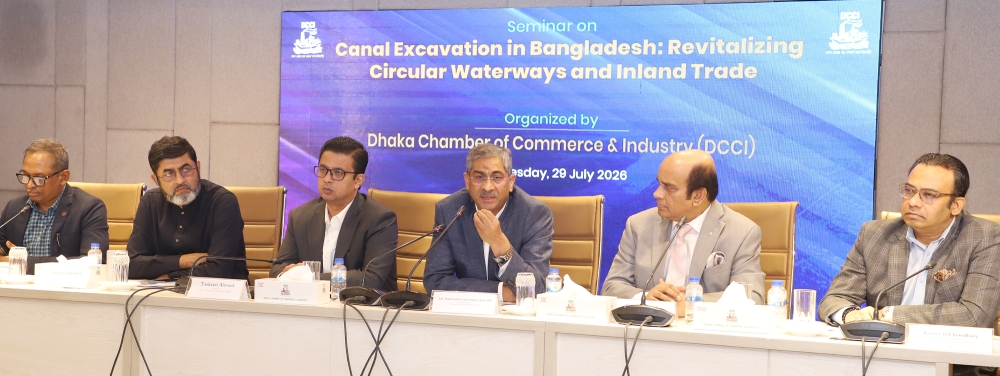
The canals surrounding Dhaka are like the arteries of the city, carrying the lifeblood of its daily economic and social activities. However, due to constant encroachment and pollution, many of these canals have become unusable. In line with the current government’s election manifesto, it has undertaken an initiative to excavate 20,000 kilometers of canals across the country to revive the waterways.
To maximize the benefits of this canal excavation programme, ensuring interconnectivity among the canals nationwide is crucial. Md. Shahiduddin Chowdhury Anee, MP, Hon'ble Minister, Ministry of Water Resources, GoB made this remark while attending as the Chief Guest at a seminar on “Canal Excavation in Bangladesh: Revitalizing Circular Waterways and Inland Trade”, organized by the Dhaka Chamber of Commerce & Industry (DCCI), was held on July 29, 2026 at the DCCI Auditorium.
The Minister further stated that to ensure successful implementation of the government’s canal excavation initiative and long-term conservation, it has formed committees comprising local government representatives and government agencies. An extensive 25-crore tree plantation programme is also underway to protect the environment, he added. The Water Resources Minister also stressed that the government would take stricter action against the dumping of industrial waste into rivers. He ensured that government is working to provide technological support to enable small industries to install Effluent Treatment Plants (ETPs) at affordable costs.
In his keynote presentation DCCI President Taskeen Ahmed stated that the condition of more than 1,415 rivers in Bangladesh is alarming. Due to years of neglect, unplanned encroachment and sedimentation, more than 55 percent of the country's rivers and canals have lost their navigability. The decline of inland waterways has resulted in 77 percent of the country's freight being transported by road, making transportation significantly more expensive and environmentally harmful, he added. Dhaka Chamber President observed that the government's nationwide canal excavation initiative is highly promising and expressed confidence that its successful implementation would contribute to flood control, improved irrigation systems, the revival of river-based rural economies and greater dynamism in the country's overall economy. He also pointed out that transporting goods by waterways costs 55–60 percent less than road transport and is four to six times more fuel-efficient, significantly reducing business operating costs. There is no alternative to developing an integrated transportation network based on the 112-kilometer waterway connecting the four rivers surrounding Dhaka. He called for effective planning and implementation to capitalize on the economic potential of inland waterways, stronger coordination among relevant government agencies and greater opportunities for private sector participation in investments in this sector.
During the designated discussion session, Architect Iqbal Habib, Founder Partner, Vitti Sthapati Brindo Ltd. & Vice President, Safety Awareness Foundation (SAF), Capt. Shawkat Iqbal, Chairman, AltaFuel Dredging & Marine Services, Md Taneem Sarwar, Senior Specialist, Head (Design), Institute of Water Modelling (IWM), Md. Motaleb Hossain Sarker, Executive Director (Acting), Center for Environmental and Geographic Information Services (CEGIS), Mohammed Abed Hossain, Professor, Institute of Water and Flood Management, BUET, Kazi Golam Nasir, Former Chief Architect, Department of Architecture, Ministry of Housing and Public Works, GoB, Mohammad Alamgir, Principal Scientific Officer (Environment, Forest and fisheries), Water Resources Planning Organization (WARPO) participated as Panel Discussants.
Architect Iqbal Habib, Founder Partner, Vitti Sthapati Brindo Ltd. emphasized the need to ensure uninterrupted river flow by discontinuing the construction of low-height culverts and bridges across waterways. He also stressed that canal excavation projects should be planned considering the natural direction of water flow. He noted that although nearly 15 government agencies are involved in river management, none has sole responsibility for the sector. In this context, he called for the establishment of a single lead institution with proper authority and accountability. He also underscored the need to strengthen National River Conservation Commission.
Kazi Golam Nasir, Former Chief Architect, Department of Architecture stated that river water should be regarded as a valuable national resource. He urged a coordinated approach to revive and protect all rivers. He also emphasized the importance of ensuring accountability among all relevant government agencies protecting rivers.
Mohammed Abed Hossain, Professor, Institute of Water and Flood Management, BUET observed that although several projects have been undertaken to improve inland waterways, their implementation is often hindered by overlapping responsibilities and institutional barriers among government agencies. To avoid this issue the mandate of the relevant agencies should be clearly defined. The professor also emphasized that formulating and effectively implementing a sound waste management policy is crucial for river conservation.
Md Taneem Sarwar, Senior Specialist, Head (Design), Institute of Water Modelling (IWM) noted that rivers are becoming increasingly narrow due to encroachment while simultaneously losing navigability because of sedimentation. He emphasized the need for coordinated initiatives to address these challenges and highlighted the importance of using Geographic Information System (GIS) and other modern technologies to delineate river boundaries and monitor changes in river courses.
Md. Motaleb Hossain Sarker, Executive Director (Acting), CEGIS proposed the establishment of an effective river management commission to oversee all river-related activities. He also recommended attracting investment under the Public-Private Partnership (PPP) model to support the development and modernization of river-based infrastructure.
Mohammad Alamgir, Principal Scientific Officer (Environment, Forest and fisheries), WARPO stated that integrated planning and effective monitoring of river management infrastructure remain inadequate and stressed the need for greater attention in this regard.
During the open floor discussion session, DCCI former President Benajir Ahmed, Director Md. Mostafa Kamal, PEng; former Vice President M. Abu Hurairah, former Director A. K. D. Khayer Mohammad Khan, Representative of BSRM Saumitra Kumar Mutsuddi among others spoke on the occasion. Speaking at the session, former Vice President M. Abu Hurairah emphasized the need for capital dredging of the Buriganga River.
DCCI Senior Vice President Razeev H Chowdhury, Vice President Md. Salem Sulaiman, members of the DCCI Board of Directors and representatives from both public and private agencies were also present during the event.
Published on: 2026-07-29